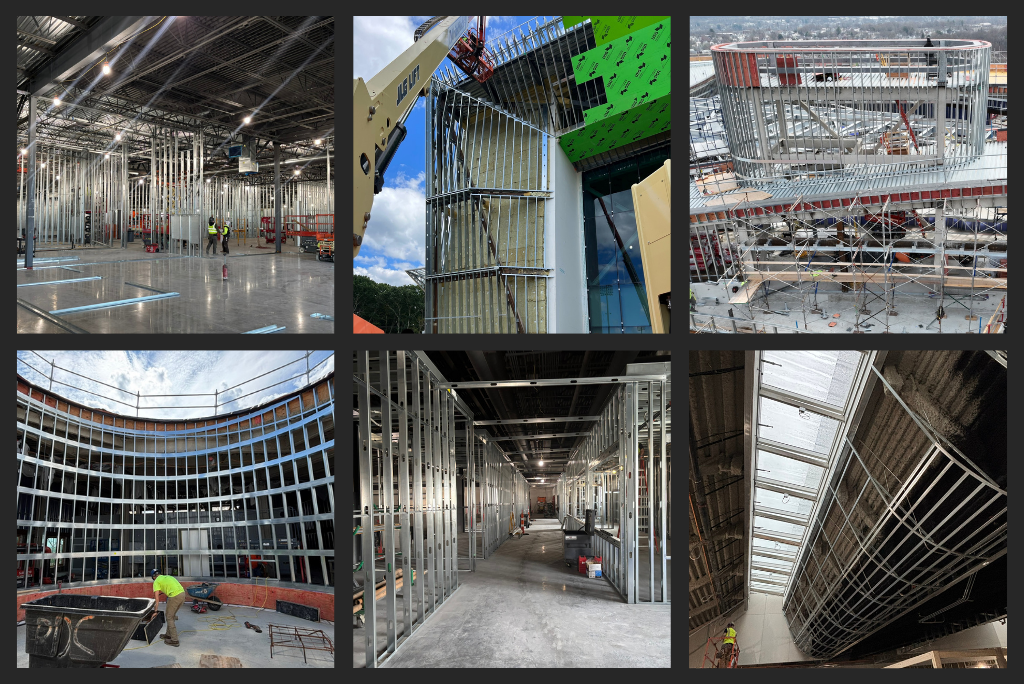
The most important systems in a building are often the ones no one sees. Cold-formed metal framing is one of those systems. Once the space is complete, it is no longer visible, but it remains essential to how the building performs, adapts, and endures.
Framing is not simply an early task to check off the schedule. It establishes the structure that supports every trade that follows. When it is planned and executed correctly, it creates clarity, efficiency, and long-term reliability throughout the build.
A Structural System, Not Just a Starting Point
Cold-formed metal framing provides the skeleton of modern commercial buildings. It defines wall locations, ceiling planes, openings, and tolerances while supporting fire-rated assemblies, acoustical requirements, and load conditions.
Unlike traditional materials, steel framing offers consistency and predictability. Studs are manufactured to precise dimensions, allowing layouts to remain accurate across large floor plates and complex geometries. This precision becomes increasingly important as buildings incorporate tighter tolerances, integrated systems, and higher performance expectations.
Framing decisions made early influence everything from drywall installation and door alignment to mechanical routing and finish quality. When framing is treated as a coordinated system rather than an isolated scope, the entire project benefits.
Coordination Begins at the Framing Stage
One of the most common sources of rework on commercial projects stems from a lack of early coordination between framing and other building systems. Mechanical, electrical, plumbing, fire protection, and enclosure elements all rely on the framing layout to function as intended.
Effective framing accounts for these interfaces before installation begins. Stud spacing, shaft layouts, bulkheads, and soffits are coordinated to accommodate ductwork, piping, and equipment. Openings are placed with intention, and backing is planned to support future installations.
This level of coordination reduces conflicts in the field and minimizes the need for last-minute adjustments that can impact both schedule and cost. Framing that anticipates downstream needs creates a smoother path for every trade that follows.
Sequencing Matters More Than Speed
Framing is often viewed as a race to get walls up so finishes can begin. In reality, the sequence in which framing is installed is just as important as the pace.
Installing framing without confirming layouts, elevations, and interfaces can lead to misalignments that ripple through the project. Correcting these issues later often requires removing completed work, delaying subsequent phases, and introducing unnecessary risk.
A disciplined approach to sequencing ensures that framing supports the intended flow of work. Layout verification, coordination reviews, and phased installation allow teams to move forward with confidence. The result is a jobsite that progresses efficiently without sacrificing quality.
Supporting Performance Beyond the Structure
Cold-formed metal framing plays a significant role in meeting performance requirements that extend beyond basic structure. Fire resistance, acoustics, and durability are all directly tied to how framing systems are designed and installed.
Fire-rated assemblies depend on proper stud gauge, spacing, and attachment methods. Acoustic performance relies on isolation, resilient connections, and consistent installation. Long-term durability is influenced by how framing interacts with moisture management, enclosure systems, and finish materials.
These outcomes are not achieved through products alone. They depend on expertise, planning, and attention to detail during framing installation.
The Foundation for Every Finished Space
Once finishes are installed, framing fades into the background. Walls appear straight, ceilings align cleanly, and systems function as expected. When everything works, framing is rarely noticed. When it does not, the issues are difficult to ignore.
This is why framing is best understood as the backbone of the build. It supports not only the physical structure, but also the coordination, performance, and efficiency of the entire project.
At PDC, we approach cold-formed metal framing as a critical system that deserves the same level of planning and precision as any finished element. By focusing on structure and coordination from the start, we help set projects up for success from frame to finish.